Sunday, October 9, 2011

Completion

Acer saccharum is luminescent in early October with its florescent orange foliage. For this reason sugar maples are one of my favorite trees.

Here in Ithaca, New York we are currently experiencing a very long stretch of gorgeous, cloudless autumn days. October is my favorite month, and 2011 certainly has not disappointed.

I am especially excited to have seen the grand opening of Marc Keane's moss garden I stumbled upon over a year ago at Sticks and Stones Farm in Connecticut. It was a wild coincidence that this moss garden was going to be installed at Cornell and I would be there to see it. I have been anticipating its arrival since.

That afternoon, a couple days ago, I made my way down the beaten path along Fall Creek. The day was pristine and the waters rushing through the gorges and down the falls left an impression in my memory. I arrived at the Johnson Museum of Art on campus and followed a group down to the newly opened wing. The sight of the garden through the expansive windows literally took my breath away, and that doesn't happen very often. We were invited to explore the officially titled Rebecca Q. and James C. Morgan Garden before the presentation began.

The stones and mosses all came from Sticks and Stones Farm (though Marc did mention that he harvested some mosses from the Cornell campus, blended it with sand and sprinkled in into the bed of the cleft, a couple years will reveal a beautiful mossy patina!). A quick glance revealed numerous species, though it is predominantly Plagiomnium cuspidatum and Polytrichum commune. I was too engaged with the holistic view of the landscape that I did not spend my time there with my face in the ground identifying all the mosses as I would normally do. I will let the pictures speak for themselves:


A perfect juxtaposition of textures.


A true master/artist/magician with stone.


An audible element of tranquility.


A group of volunteers, the Friends of the Tiger Glen, will maintain this garden twice a day, everyday to ensure its aesthetic qualities.

The curator of Asian art, Ellen Avril, started off the presentation explaining the inspiration for the garden; the Chinese parable of the "Three Laughers of the Tiger Glen", the moral of which demonstrates how overcoming differences can lead to mutual understanding and unity of friendship. This scroll depicting the story has recently been accessioned into the museum's collection.

Kano Doun Masanobu
Japanese, 1625–1694
Three Laughers of the Tiger Glen
Hanging scroll: ink and colors on silk
10 1/2 x 26 3/4 inches
Acquired through the Lee C. Lee Fund for East Asian Art
2011.025

Marc then presented the audience with his design and building process. It was fun seeing the pictures of the stonework being laid out at Sticks and Stones Farm, knowing I captured those same images over a year ago.

Here is the story of the Three Laughers taken directly from Marc's website:

"The Tiger Glen is the setting of a famous Chinese parable, often reproduced in Chinese and Japanese paintings. In the story three men, each of whom represents a philosophy or religion, experience a flash of enlightenment and mutual understanding. The story goes that Huiyuan, a Buddhist priest, lived in seclusion from society in his mountain temple, swearing never to leave its precincts by crossing the nearby Tiger Glen. One day, he was visited by two close friends: Tao Yuanming, a Confucianist, and Lu Xiujing, a Daoist. Late in the day, as he saw them off, Huiyuan was so lost in friendly conversation that he unwittingly crossed the Tiger Glen. At this, the three men broke out laughing, realizing true wisdom surpasses a strict adherence to dogma."

In the center of the photo you can see the 3 large, upright boulders (one behind the pine) representing the 3 laughers with a disconnected stone bridge that transverses the cleft in between them. The pine represents the rugged nature of the mountains depicted in many of the paintings of this tale.

Questions were taken at the end of the presentation. People inquired about his inspiration and how he laid out the stonework. To this he relayed a Japanese phrase which translated to "listen to the request of the stone". It is apparently an established way of designing with natural elements in that part of the world - such a lovely and respectful way to design in my opinion.

When someone in the audience asked how long moss lives for, Marc asked "Is there a moss expert here who can answer that?", as if prompting me to reveal myself. Timidly I raised my hand. He smiled and gestured for me to answer the question. "Ah, so you must be the one who was at Sticks and Stones," he said after my response. "I would really like it if you could map the mosses in the garden, I know there are a ton of species in there, I'm just not sure what they are." Enthusiastically I said I would love to.

At the end of the session after everyone gets up to go admire the garden again before sunset. I get up to leave and turn to see Marc standing right in front of me. We exchange greetings and he tells me he really would, honestly appreciate it if I would make note of all the species and create some type of corresponding map - as if his sincerity was not clear during the Q & A session! Again I expressed my excitement for the project! I hope to be able to make the time to do it in the next few weeks...at least before the snow arrives.

Yet another mossy opportunity has fallen into my lap :)

Thursday, August 25, 2011

Summer

It has been a while since my last post, but my summer was definitely filled with a lot of bryophyte-related activities. So hopefully this post is worth your wait!

Ponds of the Children's Garden with the brand new education center in the background.


Eleven weeks of my summer were spent at Coastal Maine Botanical Garden (CMBG) in Boothbay, Maine. I want to thank the Garden Club of America for sponsoring this internship! This was my first time to Maine (the final state on the east coast that I have visited!) and it did not disappoint.

A little population of pink lady slipper (Cypripedium acaule) in a sea of lowbush blueberry (Vaccinium angustifolium) - you would see me frequent these short shrubs in Late July when their berries ripened!


I have to say it was refreshing to return to the northeastern forests where I initially became enamored with plant life. Walking through the woods I was greeted by my old friends, Picea rubens, Abies balsamea... nostalgia rushed over me. Bunchberry, starflower, wild sarsaparilla, goldthread; I had not seen these guys in nearly a decade! They are not particularly impressive species, but I was excited enough to be reacquainted. And of course I would be remiss to not mention the pink lady slipper orchids...they are so abundant here you might mistake them for weeds!

A secluded area of the gardens appropriately named Lichen Mountain


These gardens are relatively new, officially opening in 2007. The Maine coast is an ideal spot for moss to thrive; there is magnificent species abundance. Clouds of lichens also share the terrain.

On a expedition to collect vouchers of the bryophytes of CMBG


To prevent this post from running too long I will skip ahead to the beginning of August when I got to hone in on the mosses (I was a horticulturalist for the first half of my stay). I was given a neglected parcel of garden space to transform into a spectacular moss haven. I knew it wouldn't happen in the time I was there, but I knew where to begin: weeding! This space was surrounded by a path and was mostly original native plants to the site: one red spruces and lots of numchberry. There were occasional random plantings of Asian species like bamboo, Chinese witchhazel, Japanese painted fern, brunnera and hosta... These species were immediately put on my "remove" list. Though they were accessioned already, they'll probably just be transplanted elsewhere. So I spent a few weeks tediously plucking out grasses and clover from beds of Polytrichum and Pleurozium. A good amount of moss was actually revealed after all this editing. A misting irrigation system was later installed, to encourage speedy growth!

What just a little bit of weeding can do. The ground cover consists of Pleurozium schreberi, Vaccinium angustifolium, Polytrichum commune and various lichens.


In an effort to determine which bryophyte species were living on the property I went collecting. I traversed the shorelands, uplands, wetlands, rock outcroppings and cultivated areas. I collected 50 specimens total. I should mention that I only sampled a small percentage of the total property, though I made a real effort to at least sample areas representative of all the different ecotypes there. Still I'm sure there are many more species yet to be documented.

An expert-in-residence keying out mosses.


I spent a week as the "expert-in-residence" in their education building. There I sat staring down microscopes and thumbing through numerous keys trying to identify some of these plants. Occasionally a visitor would stop and watch me through glass wall that divided us.

The bryophile bunch!


Joanne Sharpe, a known fern fanatic and docent at the gardens, told her local moss group about my arrival. So during my residency the fellow enthusiasts stopped by for a little tour of the species I was finding. I was skeptical I could impress them with the species I found, assuming they were old news to them, but to my relief they all seemed excited to see them all. Ralph Pope was one member of this group. He brought with him his soon-to-be-published moss field guide, He generously offered to send me a copy of a final draft when he gets to that stage, I look forward to that!

Demonstrating the moss lifecycle with a female Polytrichum commune gametophyte


At the end of that week I conducted a moss walk for interested visitors and I was happy to see a nice group show up. After a brief explanation of moss biology with a volunteer Polytrichum commune female and a tutorial on hand lens operation, we headed out. We stopped at various spots in the gardens where I identified diagnostic field characteristics for common species and explained their ecology; how they affect and respond to their environment. Everyone seemed very interested and asked tons of questions, which I love! One woman even returned to my office with her friend and explained how I had completely changed her perspective on plant life! That was so wonderful to hear.

My antique microscope got a lot of use that week!


I determined I had collected 35 species of mosses and 4 species of liverworts. I divided each voucher in the collection into thirds; one third will stay in the soon-to-exist herbarium at the gardens, one third will go to the Farlow Herbarium at Harvard University, and the last third will stay with me in perpetuity. In corresponding with a woman at the Farlow, I may soon be able to annotate some 19th century bryophyte specimens!

Intermittently during the rest of my time in Maine I was working on a visitors guide to the mosses of CMBG. This brochure covered the natural history, biology, ecology and identification of bryophytes. I really went to town on the text, I'm sure it will be whacked back a bit in editing. It should probably get published someone next year, so look for a PDF on their website. It will also include a self guided tour of several common species on the property.

Bill Cullina was nice enough to give me a tutorial on how to actually operate my DSLR camera. I've had it for several months now, but never had the time, or anyone willing to help me learn how to use it! Enjoy!


Sunday, May 1, 2011

Gardens

For three days last week I was on a whirl-wind tour of the public gardens in and around New York City. I must say I am impressed with the amount of community outreach, conservation and research these institutions are involved with. These behind-the-scenes tours allows you to see beyond the plantings and understand just how important gardens are to cultures, education, reserarch and conservation.

I absolutely love watching people enjoying the gardens. I love it. It stirs within me this profound happiness. For me, aside from retaining the biodiversity of plant life, it makes the existence of gardens worthwhile when mankind takes pleasure in all they can offer.

While on this trip I have witnessed a quiet passion for mosses in public gardens. After telling someone about my mossy ambitions I always receive a positive reaction. The general reaction being "oh how lovely, what a wonderful thing to study!" and always followed by a genuine smile. That kind of affirmation honestly warms my heart and eases any worries that people have no interest in bryophytes, and gardens may actually benefit from my graduate research.

Wave Hill


Wave Hill House situated in a peaceful, intimate part of the Bronx.


Prunus 'Hally Jolivette' creates a cloud of tiny, deep pink flowers.
The horticultural specimens in this garden are absolutely amazing and beautifully maintained.


On this perfect sunny day it was wonderful to see so many families meandering the gardens.

New York Botanical Garden


I am in love with the Library Building with its Corinthian columns and copper embellishments. I fell even more in love when I saw the bryophyte exhibit inside. The amount of research this garden in the Bronx does rivals any university.

The rare book, Historia naturalis palmarum has this beautifully detailed hand-colored chromolithograph by Karl Friedrich Philipp von Martius, Morenia Poppigiana. NYBG has a dedicated, climate-controlled room that houses a historical collection of rare books and folios


I couldn't help imagining myself as this woman incarnated. I too have spend a good amount of time staring down the eye piece of a microscope.


NYBG has one of the largest herbaria on the planet with over 7 million specimens. This Chiliotrichus amelloides was collected on Captain Cook's first voyage in 1769. Someone commented on all the re-identification labels on some of the specimens and it reminded me of the time I spent working in the Smithsonian's National Herbarium keying out Gnetum species. It's pretty cool having specimens in a large herbarium with your name on it as the identification authority.


Queens Botanical Garden

So many people flock to this garden in Queens to do various exercises, like Tai Chi and dance, in groups or individually. The entire place had this healthy atmosphere. This garden was so accommodating of all peoples, being in the most culturally diverse county in the nation, with its multi-lingual interpretation signage. It felt really great to be surrounded by such diversity, the garden's mission, "where plants, people and cultures meet" is very apparent here.


Though it was a small garden, it had some very beautiful vignettes. No surprise, every garden we went to had a plethora of bulbs.


An explosion of color! Unfortunately I never got a picture of their little experimental moss garden, which is just off the lower right side of this picture. They established it a couple years ago using some found rotting logs and mossy rocks.


This garden is doing amazing things with sustainable practices. This new LEED platinum certified visitor’s center is complete with a water-cleaning system, composting toilet, green roof, geothermal heating and cooling system. This 16,000 square foot building uses 82% less water than a conventional building of the same size!


Planting Fields Arboretum

This grand estate-turned-state-historic-park on long island was owned by William Robertson Coe and his family. The gardens are known for their camellia (as seen above), magnolia and rhododendron collections.


Coe Hall is a magnificent manor that has been converted into a museum. Also commonly used as a backdrop by many wedding photographers. I two newly wedded couples were spotted that day.


Somehow this garden was able to include many Daphne specimens in their collection; a finicky but beautiful plant. I'm going to say this is a D. genkwa, but I didn’t get a look at the label.


Old Westbury

This is the most beautiful estate home I have ever seen. No wonder it has been used in many movies. The front overlooks an extensive allee of beeches, where in the back an allee of old hemlocks reaches nearly to the Long Island Expressway.


Amidst the mist you can see the Temple of Love. Even with hundreds of tiny girl scouts running around and photo shoots taking place, this place has many quiet, intimate spots that make you forget you are stone's throw from NYC. No wonder this garden has been recognized as one the top 3 best public gardens in the world.


Brooklyn Botanic Gardens

Not only does the signage in their sensory garden have Braille, but the stone retaining wall has been elevated from the ground a couple inches so that the visually impaired can feel comfortable resting their toes beneath it when interacting with the plants.

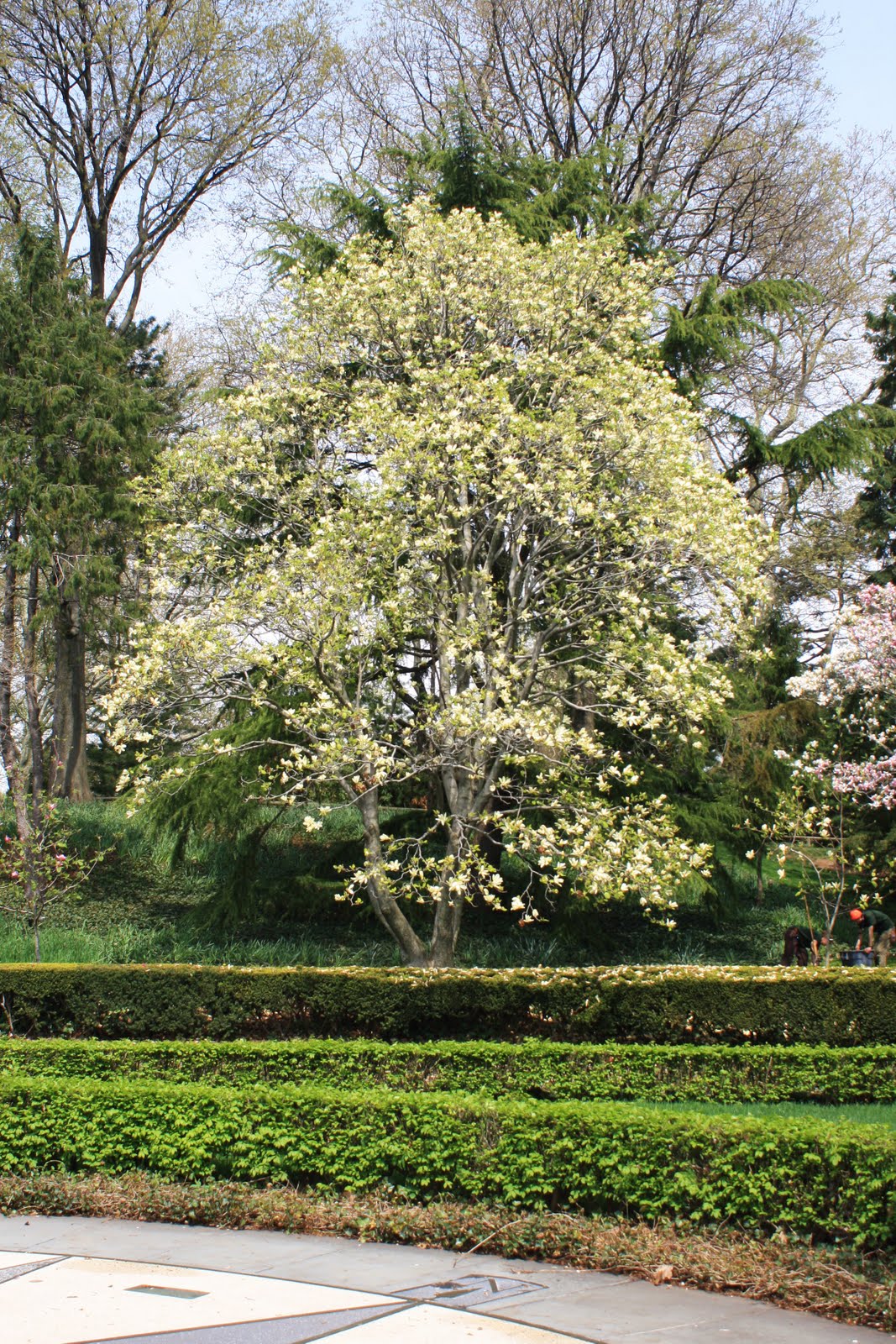
Betty Scholtz, advised me to make sure I see this original specimen of Magnolia 'Elizabeth', a cultivar that may or may not have been named for her. It is my favorite magnolia cultivar by far.

The hue generated by these flowering cherries is so brilliant, it was like walking beneath the vaults of a pink cathedral.

I was very impressed to learn that Brooklyn Botanic established this native plant garden in 1910. The general theme of this garden all around was "ahead of its time". They were also very dedicated in their beginnings to childrens education. Another of my favorite plants, Fothergilla is in the foreground with its pretty, honey-scented bottle-brush flowers.

I would not be possible for me to tell you which garden was my favorite. I can honestly say I was blown away be every single one of them. Each had their own specific mission and focus which allowed them the creativity to be unique to their geographic area, or demographic. Gardens are hardly just a place for cultivated plants, though, of course, that is what makes them beautiful. Next time you decide to take a day to wander around a public garden see if you can find out what they are doing actively whether related to greener practices, community involvement, education, scientific research or conservation. They do amazing things.

Sunday, April 24, 2011

Vegetate

If there is one thing that this planet cannot get enough of it's eukaryotic multicellular photosynthetic organisms. So if you happen to reside in a ecosystem comprised mostly of concrete and steel, go ahead and help sequester some of that excess carbon from the atmosphere and express yourself at the same time with guerrilla gardening