Friday, November 26, 2010

Scale

I am a scientist. Yet I understand that my personal life experiences and the clairvoyance (ability to read hidden messages in something) I detect in any event, as trivial as they might seem, are incomprehensible to anyone else but me; it is the way I understand the universe communicates with me.

An astrologer once advised me to follow my bliss, and only then I would lead a truly happy life. I would simply have to listen to and follow my intuition in the form of, “good feels good, bad feels bad” and opportunities will open up. The astrologer put into words what I have always felt but never consciously realized: I was put on this earth to break boundaries and stand up against the status quo. He told me I will be the one to develop new standards in my field and be an imparter of visions of the future. Of course I am not the type to accomplish this on a large-political scale, but within my own realm: my spirituality, my occupation, home-life, eating habits, et cetera. I can see myself as the first one to develop a manual in bryophyte curation techniques that will be adopted by gardens, perhaps the first to develop moss propagation techniques on a larger scale, aiding in the first comprehensive moss field guide. I embrace the idea of being different and unique; I could never want to be like anyone else but me.

A little while ago my bliss took me to Denver, Colorado. There I got to mingle with fellow plant curation and nomenclature geeks at the APGA Collections Symposium at Denver Botanic Garden. On the plane ride over I mostly had my nose glued to the tiny airplane window. The earth looks pretty amazing from up there in the troposphere. Viewing the world from that level I could see the gradual elevation differences in the topography. During autumn it is a lot easier to view the species distribution along particular microclimates. It is absolutely fascinating to view the landscape at this point in geologic time and reflect on the evolution of the planet from its inception and how life has colonized their preferential niches within the undulating land carved by glaciers several thousand years ago. Looking out at the forested areas below, the only thing I can think of is moss (of course). From this altitude the dense trees blend together creating these turfs and tufts along the land, just like moss does from our perspective. I liken this high-altitude view of the forest below as analogous to our human view of moss from our natural height. The same natural, microclimatic forces apply in the colonization of tree, shrub and herbaceous plants species along a vast expanse of land as it does for moss species along its substrate.


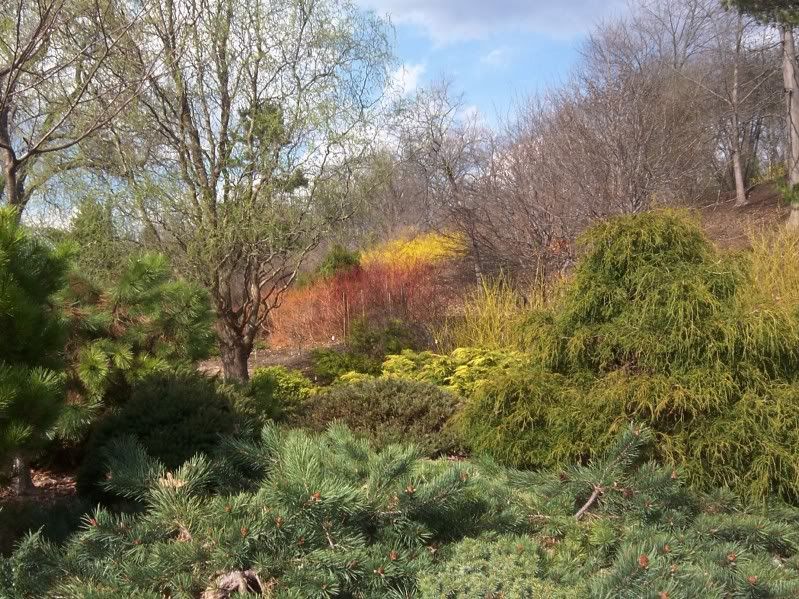
Really cool way to display teeny alpine plants! If only there were moss displays like this somewhere...

I am grateful to be aware of the clarity I am experiencing at this point in my life. Things are just clicking, just as the astrologer said they would. Apparently as this year is my time to wrap up some loose ends, the 1st quarter of the next year will mark some new beginnings. I cannot wait to see where my bliss will take me next!

Sunday, October 17, 2010

Destiny

I have recently come to the realization that once you find your true calling in life, opportunities will fall at your feet. It has been almost comical how many people and opportunities I have run into these past few months while venturing through my life on this moss-covered path. These events are reinforcing the universe’s plan for me, as if it whispering (or shouting) “Yes, Stephanie, you are on the right track, keep going” and with each subsequent experience I gain motivation and encouragement.

Robin standing above a stone inlaid with salamander carving explaining how not only does the carving provide the perfect microclimate, but also because mosses are considered the amphibians of the plant kingdom

Earlier this month I attended a moss workshop hosted by Moss Acres in Honesdale, Pennsylvania. I was especially excited to attend this workshop because Robin Kimmerer was going to be a guest speaker and, well, we had so many things to discuss! The small group consisted mostly of landscape architects, designers and gardeners – okay, all except me. In the introduction it seemed apparent that most were there to learn how to grow moss in gardens…fast. This made me nervous. Moss is not speedy by any means, and I was afraid everyone would walk away with the notion that there is no such thing as instant moss gardens and to just give up on the idea or be prepared to deplete the local forest of its moss reserves. But these fears were put at ease as the day went on.

Al Benner gave some background on the property and their business (began by his father, David Benner) then Robin began with a little background on the evolutionary history of mosses. She reminded me of something fascinating: due to its derivation from bottom-of-the-sea dwelling algae, moss has retained its adaptation to photosynthesize at very low light levels (think not much light reaches the bottom of the ocean). That’s why it flourishes in the shady forest and underneath a thick blanket of snow. In fact there is a moss thriving happily at the bottom of Crater Lake, Oregon (over 1900 feet – the deepest lake in the US). One of the things I love the most about Robin’s approach to teaching mosses is to never forget their beauty, both within its simple physiological processes as well as the aesthetics it provides on a larger scale. Robin describes moss as “time made visible”. That is one of its greatest attributes, its ability to alter our human minds to perceive “old age” when seeing it blanketing its substrate.

Al Benner standing on their green roof

The staff proudly showed us their green roof experiment on top of a spring pump house. It looked great! I’ve been trying to advocate for the use of mosses on green roofs: they are very drought tolerant, and require a lot less substrate. They had inoculated the roof aggregate with Hypnum imponens 2 years ago and it was taking off great. This past spring, however Thuidium delicatulum took over and spread like wildfire, completely out-competing the Hypnum. Thuidium is well known as a “volunteer” species, but we weren’t complaining. In the near future they want to construct a sun-loving-moss green roof. Al took us to a sunny rock he found that had a few species growing on it and asked for their identities and if these were good roof candidates. There was Hedwigia ciliata (always found on roofs) Bryum argenteum and Cetatodon purpurea – all wonderful selections for a sunny roof! Those species would create a beautiful mosaic of color and texture on a rooftop.

Beech Grove

Our group moss-planting project ended up really being an exercise in understanding the “natural destiny” of an ecosystem: alter it any way you want, it will always want to revert back to its original state (though the extent of its originality that returns will vary). We were taken to a little beech grove at the edge of a forest with a large boulder perched to view the valley below. Immediately the group began ripping out some of the invasive vegetation and sweeping off the leaf litter from the boulder. A few of us stood back and watched a little confused as to what we were trying to accomplish here. Those who jumped in couldn’t help not noticing that the instant effects they were trying to gain by removing the vegetation and debris would only increase the erosion and wind potential in that area. All that exposed, rich humus beneath that leaf litter on the boulder would be washed away instantly. Those of us who stood back encouraged Robin to speak up: The reason why it accumulated there in the first place was because of the slope and location of that rock – its natural destiny is to accumulate leaf litter – a destiny that does not include moss (it cannot survive being smothered by debris). So creating a moss garden on that rock would only be possible if there was maintenance in removing the debris and keeping it moist (there would be water loss due to the slope of the rock). I explained that a moss garden would be possible, but it would require a lot less work on your part if you work with the natural tendencies of that ecosystem rather than fight against it. I mean, the reason why it was chosen in the first place was because it was already a special and beautiful spot; why change it?

Al exhibiting the difference in moss growth using the “milkshake method” under a biodegradable film compared to no cover (the uncovered experiment is to the left of that mossy patch

The workshop introduced ideas of “tricking” the moss into growing at a faster rate. This is what put me at ease when I feared that the attendants would not learn that moss can grow relatively fast. I already put these conditions into practice at the private estate I worked at, and shared my successful experience (Side note: I discovered this private estate was the very same one Robin wrote a chapter on in her book, I took that shared experience as another reinforcing link between us Bryophiles, really what are the odds?). I might disclose these “tricks” later on (this post is long enough), but I will say that is it just a matter of lengthening that normally short period of time when mosses can actively grow.

I loved getting to chance to sit down with Robin and the other attendants over a nice hot bowl of delicious lamb stew and talk moss. I brought up some ideas I’ve been contemplating in tackling the issues associated with curating mosses in public gardens (which happens to be the focus of my thesis). I was commend on my ideas and got great new ones. Robin also expressed her desire to create a moss field guide book and in passing I offered up my services if she needed any help, and with intense sincerity and seriousness in her face and voice she said, “Stephanie, I would love for you to help.” I was surprised and elated by her invitation, and still very excited at the prospect of helping develop a field guide to mosses: another great future opportunity!

Robin teaching us the ecological implications of preserving mosses in their natural habitats and other roles mosses play in nature

I was also happy to be proven correct in my hypothesis that the idea that mosses like acidic environments is not just because they like low pH, but because in very acidic soils many of the essential nutrients are not available to vascular plants, and therefore cannot grow there. Since mosses don’t acquire their nutrition from soil, they will happily just take over the spot that the vascular plants can’t. I’m not sure how widely known this idea is already, but I was just happy to be able to independently link these two occurrences together for my own little “a-ha” moment.
Another hopeful future goal is to develop ways to propagate mosses in a nursery setting – Robin and I agree that wild collection, however “sustainably” the collectors are gathering, is not the way to go. Those essential growing conditions would not be difficult to control, and I’m not aware of anyone who has tried.
This was such an amazing opportunity to learn, teach and network. It certainly won’t be the last time they see me! There is still so much work that needs to be done to bridge the gap between mosses and the public, it will certainly keep me busy for years to come, it is my destiny after all.

Robin Kimmerer and Cathy Cope

Thursday, September 2, 2010

How?

It is time again for the 4th installment of my 6 part series "Better Know Your Mosses"!

How do mosses survive?

That is kind of a large, broad question. There are several factors that contribute to the survival of any living organism. I will keep this simple and focus three points that contribute to the success of mosses:

Mosses are poikilohydric. You rarely come across this word in biology. Basically it means that mosses do not have the ability to retain water. They do not have advanced tissues to help hold in water during periods of drought to keep photosynthesis going. Think of it as being "cold-blooded" in the plant kingdom: if it is wet, mosses are wet; if it is dry, mosses are dry.

Here's a more in-depth look: The average moss leaf is only 1 to 2 cell layers thick as opposed to several different, specialized layers found in vascular plant leaves. Moss leaves do not have an epidermis, vascular system or even stomata to regulate gas exchange and water retention like higher plants. Nutrients and water are absorbed directly into their cells from their environment. This lack of conductive tissues is also the reason why mosses are so small - they don't have this interior structure to hold them upright and allow them to grow higher like vascular plants. Of course those species that have the hydroids and leptoids (those nearly-vascular tissues) tend to be bigger in form.

A dessicated Grimmia. It really looked quite black from a distance. Here you can at least see some green showing through the silvery awns which aid in light reflection.

Grimmia, rehydrated. A much more lively appearance.

Okay, so how is it possible mosses have survived hundreds of millions of years if they can't even master the simple task of holding in water? Amazingly they can lose up to 98% of their water content and still survive! Upon dessication they enter a state of suspended animation. Everything freezes, including respiration and photosynthesis (both of which require water to function), and the plant waits for the arrival of that ever-so-essential liquid. The phrase "patience is a virtue" resonates even within the micro-mossy world.

You have probably already witnessed this neat little adaptation when coming across dried up, crusty clumps of moss on rocks or other dry surfaces. That moss is not dead (unless its yellow or brownish - then maybe it is), but if it is still a shade of green or even blackish in appearance, then it is still very much alive - just not kicking. This ability to go dormant in the absence of water gives moss a special advantage over any other plant: they are incredibly drought tolerant. Need a candidate for your green roof project? Look no further!

Of course this does not mean mosses are immortal. All species have a different level of a dessication tolerance - some more than others, and this can be directly related to their morphological variability (more on that in the future). No moss can live forever in suspended animation, though some can wait weeks, months, years or decades before water comes around again, and they will happily reanimate and go about their mossy lives.

Here's something you could do to watch this reanimation. Next time you come across a shriveled up mass of moss, give it a little drink and watch the leaves thirstily soak up the water and begin to unfurl right before your eyes - some species will even dance for you :)

Mosses are adapted to live in the boundary layer. This is why mosses are happiest in rock crevices or a muddy footprint. I have explained this awesome evolutionary adaptation in my "Wind" post. Be sure to check that out if you have not already!

Finally, mosses have a haploid dominant generation; their dominant generation is the n condition (has 1 set of chromosomes); or to phrase it yet another way: only in bryophytes can you find that the gametophyte is the main generation you see (ergo, dominant) and the gametophyte is always haploid in any plant species. (Please see my What? post for a more detailed/simple explanation of this unique life-cycle).

What possible advantage does having only 1 set of chromosomes in their dominant generation give them? If you think about it, this n condition possesses “immediate fitness”. Any unfavorable environmental conditions would immediately select against unfit mosses; they would not have a chance to pass their genes to next generation. It gives them a "speedy evolution" so to speak. They don't have much of a chance to hold onto recessive genes until conditions become favorable enough to disperse their progeny like a vascular plant can.

Perhaps a story can better explain it. Note: You will need to believe that evolution is, in fact, a real phenomenon!

Once upon a time, on a dry rock face, far, far away, a brand new generation of moss was born. He was named Bryum. It just so happened that the genetic combination of Bryum's parents' gametes resulted in a genetic code that caused Bryum to express a particular trait; Bryum had especially sparse and narrow leaves compared to other nearby populations. Poor Bryum was picked on by the others because he couldn't hold as much water in his capillary spaces like everyone else, and living on this hot, dry rock face, water-holding capacity was pretty essential. Tried as he might, Bryum just could not continue living this way, and after a short while Bryum died; he never even got the chance to make little moss babies of his own...

I didn't say this story would end happily ever after... but here's the moral: you better be suited to your habitat if you want to pass on your genes and give your offspring a fighting chance. It's a good thing that Bryum died, because if he lived long enough to make moss babies he would have passed on his thin-leaf genes them and they would have equally bleak futures. So goes nature's mantra: Survival of the Fittest. Poorly formed mosses will die out a lot faster, killing off those undesired traits at a much faster rate than would happen if they were much bigger, bulkier and tougher; able to weather through the tough times - but that would slow their evolution. So that's why mosses have remained largely unchanged for 350 million years - they were evolving at warp-speed from the beginning!

Chew on this: In bryophytes the sporophyte (wiry stalk with capsule that holds spores) is dependent on the gametophyte (the leafy green part). This means that if the gametophyte dies, it couldn't produce a sporophyte and thus its genes die along with it - that's it, no second chances for that generation. But in vascular plants the gametophyte (pollen and embryo sacs) is dependent on the sporophyte (the tree, shrub, or herb). A tree can keep sending out the same genetic information over and over again, whether or not conditions are favorable. If its gametophytes die, it can just keep on making new ones, dispersing it's genetic information in perpetuity in hopes that some of its offspring will be successful.

Despite their small stature, mosses are quite tough on an evolutionary scale - not to mention innovative! How amazing is it that they can just freeze in time without water and after it returns just pick up right as they left off and go about their lives? (Though the process of rehydration is a little more complicated than that). It's a good thing mosses didn't lose this trait over time, because without these qualities mosses wouldn't have a fighting chance against higher plants. The ability to colonize and adapt to those little spaces otherwise neglected by larger life forms definitely adds another dimension to the natural world - search them out next time and ask yourself "how do they do that?".

Stay tuned for the next installment and learn just how many shapes, sizes and colors mosses come in!

Thursday, August 5, 2010

Return

On the last Saturday of July I returned once again to Sticks and Stones Farm in Newtown, Connecticut (see previous post for that adventure) Tim Currier invited me to come back and see the progress on the garden he was building for Marc Keane, so of course I took him up on this offer! The following photographs document my visit:

Entrance Sign - hard to find if you don't know where to look. It's a good thing I already knew where this place was after passing it everyday - your GPS will tell you you're arriving there a few miles before you get there!

The stone barn.

Cool twig structure.

Cool truck.

The work site.

If you squint you can see that the stones snake around to create a ravine, if you squint harder you will see some red and yellow lines on the stones marking grade level, so there will be mosses covering up to those lines. The 3 large stones in the back are the Priests.

Tim displaying the patio - the only stones that did not come from his property. To his left will be a large stone/water feature.

Tim pretending he is the large tree that will occupy that space. There will also be a wooden boardwalk that will wrap around the 400 square foot garden.

Back to work.

Woman pressing Climacium dendroides into the labyrinth.

Pile of sifted "moss soil" - very soft and acidic.

Trays growing Climacium dendroides in a lowland area.

Moss chosen to work into planters...

...like this one. Beautiful.

Hypnum imponens growing out of Leucobryum glaucum.

Quercus evidence.

Wonderful layered texture of the tall deciduous trees, the twisted branches of the Kalmia and the dense, bubbly Leucobryum et. al. turf.

The shiny, curly leaves of Hypnum imponens.

Sun kissed.

:)

Monday, July 12, 2010

Connections

I’m a firm believer that everything happens for a reason. Sometimes when and why events occur seems to be a direct result of past occurrences; events that otherwise wouldn’t have occurred had some instance never happened prior. You could say it is the hand of fate weaving this interconnected tapestry. My life is filled with these silly coincidences – as if the universe has a plan for me. Maybe it does.

Last Saturday I found myself driving down a particular road past a wholesale nursery where I worked a few years ago – honestly a place I would rather forget. In all seriousness, the fondest memory I have of this place is driving down that road back home with the biggest smile on my face and laughing after my last day of working there.

Everyday I would drive past Sticks and Stones Farm. I knew they grew moss there, which was enough for me to want to visit! Yet it felt like something was telling me not to stop in; perhaps the universe didn’t want me to install a potentially wonderful memory among memories of a time in my life I didn’t want to remember.

My chance came three years later. I turned down their gravel road and walked towards a stone barn. I was greeted by Annie. I told her my reason for my visit: I was thinking of developing my grad thesis around the curation of bryophytes in public gardens. Seeing as how gardens can acquire plants through farms like this one, I wanted to learn how they do their thing. Annie was intrigued and delighted to have me there. She peeked around the side of the barn to find a young man named Andrew working with beautiful hand carved stone planters filled with moss. She told me he would be happy to answer some of my questions.

As we strolled around the property, Andrew told me the farm is technically a working preserve. Not only do they cultivate moss, but they also excavate large stone erratics from the property as well as hold workshops and retreats. We walked a path along the base of a hill side covered in Kalmia latifolia (mountain laurel) with a thick, unfragmented carpet of Leucobryum glaucum (pincushion moss) underneath as far up the hill as I could see - it looked immaculate! What was their secret? Well, I’m not going to give it away :)

Down in the lowland areas I could see hundreds of trays filled with Climacium dendroides. He showed me a labyrinth he was in the process of constructing. he tells me it is modeled after the one in Chartres Cathedral. The project was only partially filled with Climacium. He didn't want to continue since the moss he planted wasn't looking too happy. I commented that the area was pretty exposed under the thin, deciduous canopy and the gravel path didn't really provide a very saturated environment for that species, and that could explain its sad appearance.

When we arrived back up at the barn, Annie told me of a book she just started reading and thought I would enjoy it. I laughed when she retrieved a copy of Dr. Kimmerer’s book, Gathering Moss. She got a kick out of hearing about my connection to the author. At this point, Tim Currier, owner of the farm and Annie’s husband, came in. Annie served us a delicious banana-coffee milkshake as I told him the reason for my visit and my plans to begin grad school at Cornell. He mentioned he was just about to begin a Japanese-style moss garden project for a landscape architect-friend of his, Marc Keane, to be installed next spring at the Johnson Museum on the Cornell campus. He showed me some CAD drawings of this project titled, “The Garden of the Tiger Glen”. This future project will feature a 400 square foot area with a carpet of moss (Tim is thinking of using Mnium), an 18 inch deep ravine made of stone cutting through, three large stone “kings” and a large tree coming from Pennsylvania. Tim will build the garden onsite later this month (I plan to return later to check on the progress before I move to Ithaca). It will then be disassembled and transported to the campus. I am very excited that I stumbled onto this project when I did. I get to see it as Tim constructs it and the finished product next spring at Cornell! What are the odds…

But that’s not the only exciting that happened on my spontaneous excursion. Annie told Tim about my connection with Robin Kimmerer and he said that since reading her book he has wanted to view mosses under a microscope to see them as Robin describes. He then went to retrieve an old microscope he found in an old house he acquired on his property. He had no idea how to use it, but luckily for him he had all the essential instruments and a certain individual who knew exactly how to use them – me! We went out and I plucked a small bit of Mnium cuspidatum and Polytrichum commune and proceeded to mount them on slides. Only his 10X objective was functional, but it was enough to make him say “Wow!” when he stared down the eyepiece. He called over a couple other people to come and check it out – both with the same exclamation. Thirty years working with mosses and this was his first glimpse into what mosses really look like. Tim was absolutely delighted to have been taught this lesson and excitedly extended an invitation for me to come back whenever I wanted. If there was ever any work or studies I wanted to do with mosses, his property was available - which was amazing. As we parted he verbalized his hope of setting up a “moss camp” so that others can see what I revealed to him today, and of course I offered my services as an instructor.

And so there I was again driving down that road, the biggest smile on my face and laughing – so happy to have made those connections: between me and them, between them and moss, and between me, them, moss and Cornell. I love to reveal the mysteries of moss and see the people’s reactions; to show them something that is hidden to the naked eye, only viewable with an ocular aid.

So I arrived as if called by these people at a time when they needed me – just as they were going to begin this large project for a large university, just as they began reading Dr. Kimmerer’s book and needed help in getting a glimpse into the microscopic world of mosses. It's a pretty small world after all...

Note: I will add pictures once I return to check out the progress on the moss garden...I will remember my camera next time!

Thursday, July 8, 2010

Wind

If I could pick out one card out of the Tarot deck to represent my life as of late it would be the Wheel of Fortune. I have been the victim of this force before. Perhaps you have been subjected to it's wheel-like actions, unexpected encounters, twists of fate, unpredictable surprises. Unfortunately sometimes it's energy can have adverse affects. You will start to feel your life speed up drastically, make you feel as if you were caught in a cyclone, depositing you somewhere unexpected, leaving you terrified, sick and disoriented. Only recently have I recovered from my storm; the clouds are clearing and I have found my way onto a path - but the winds haven't quite settled down yet...

I tallied it up. Since 2006 I have lived in 4 states and worked in 5. I have moved 8 times (9 come August) and have had 10 jobs. I look forward to the day where I only need to file one state tax return. It appears as if I am portraying myself as a restless nomad....

This time I'm not just going to ride the winds of change; I'm taking a more active approach. A little over a month ago I had to pack up my life (again) and move to the Hudson Valley in New York. I am working at a large private garden/estate there to bide my time before classes begin. There is very limited internet access here - which explains my long absence - I do apologize...

In keeping with the theme of this blog (though I am entitled to my non-sequiturs), let me discuss the importance of wind in the life of a moss.

Air movement is essential to the distribution of their progeny - an assurance of succession; at least of genetically variable offspring that can give their species an upper hand in colonization.

For the most part - and if you squint really hard - mosses overall have a similar morphology. You will see that they perch their spore-filled capsules on top of a (relatively) long seta. Why expel so much energy into producing such a long wirey stalk? I think to answer this question I should discuss the role of the boundary layer in the life of moss.


The Boundary Layer. Taken from Gathering Moss by Robin Kimmerer


Above is a diagram taken from Dr. Kimmerer's book, Gathering Moss (again, if you haven't already, go read this book!). The boundary layer is a phenomena that can be found on any surface - be it the surface of the earth, or the surface of a leaf. This diagram shows how air moves across a surface: the friction the air encounters as it brushes against the surface creates turbulence, the area just at the surface has very little air movement, and the area above the turbulence moves freely.

Mosses have created a perfect little niche living within this micro-boundary layer. Their lack of vascular tissue makes them tiny and perfectly adapted to living closer to a surface. What does living within the boundary layer provide? More heat, water and carbon dioxide can be trapped in this area and isn't easily blown away - especially after a moss has colonized it creating nice little pockets within its leaves to hold onto these precious elements.

But when it comes time to release the spores, they don't need heat, water or CO2, just the wind. So they poke their little capsules up through the turbulence into the free-flowing air to be whisked away to another suitable habitat. The wind can carry spores miles up into the atmosphere. It's no wonder they can be found on every continent; they certainly are perfectly adapted to go with the flow.

Friday, April 16, 2010

Recognition

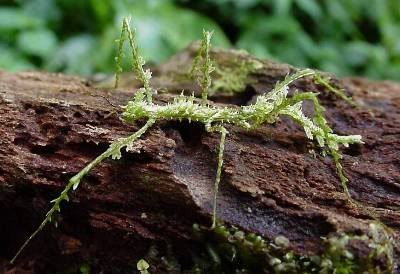
I was quite excited to see that IAB blog generously acknowledged my blog after I commented on a photo of a super awesome, bryophyte-mimicking phasmid, Trychopeplus laciniatus


This species is found in Central America and as I understand it, not much is known about its relationship with bryophytes, but it's definitely spectacular looking!

On another note, today, after 8 months of wishing, studying, traveling, networking, intense energy focusing and anticipation, I have finally heard the news I have been waiting to hear: I have been selected as the new fellow for Cornell Plantations Graduate Fellowship in Public Garden Leadership! This year only one position was available for this fellowship making the waiting even more nerve-wracking. After hearing the news I promptly started jumping up and down, squealing, dancing, laughing, crying and in general going strait up bananas.

Ever since my curatorial internship at Mt. Cuba Center, I have set my sights on following (or perhaps in my case, blazing) a path to become a curator of a botanical garden. Talking with Amy Highland, the plant recorder at Mt. Cuba, enlightened me to the prospect that perhaps not all is lost in trying to find a career working with plants that did not involve retail/wholesale, angry/unreasonable customers, mindless deadheading/weeding, etc. It nearly blew my mind that there was someone out there who shared my passion for plant taxonomy, and I would spend the next several months working with her!

I figured the next step in my journey was to attempt to go back to school. Of course there are only 2 institutions who offer a Masters in this field: Cornell University and University of Delaware (Longwood Gardens Graduate Program). I really wanted to go back to upstate New York and Cornell was my chance! Plus I have an affinity for plants of the Northeast, sorry Piedmont...

Winter Garden at Cornell's Botanical Garden

Earlier this month I made a trip up to Cornell University in Ithaca, New York to give a presentation to a selection committee consisting of directors, professors and fellows on my past, present and future interest in the public garden field - basically an interview. Of course I talked about my mossy endeavors at Mt. Cuba which seemed to strike an interest in the panel. But what really got them going was my announcement that I would potentially like to tackle the ever-so-controversial topic of the misuse of trademarks in horticulture for my "action project". This ignited a 10 minute tangent questioning the importance of nomenclature consistencies in horticulture between the members of the panel (everyone having their own opinion). At that point I could safely say that my presentation would not be forgettable, and perhaps that was a good thing.

Not only is Ithaca "Gorges" but it is also full of beautiful mosses (I wouldn't be myself if I didn't go mossing around the area). One in particular caught my eye during a little trip around town. I eventually found myself in front of Ithaca Falls, on the west side of campus, and there, covering a rock face was Bartramia pomiformis.


I had never seen this moss in the field, but using only memories of drawings in my moss books I instantly recognized this distinguishable species. This delicate moss forms bright green, loose turfs, that to me, create a texture reminiscent of Hakonechloa on a miniature scale. Perfectly round capsules float on short setae, giving them a celestial appearance. I just love the juxtaposition of textures between the gametophyte and sporophyte. The common name of this bryophyte is apple moss - alluding to the pome-like sporophytes.

Here's to embarking on new beginnings...